Thursday, 15 November 2012

Session 7 - 15th November 2012

This week's session was a full day fieldtrip to Morecambe Bay and Leighton Moss RSPB in Lancashire. There was a high tide at about 11:30am and so we had hopes of the birds being pushed inland giving us closer views than usual. After a fairly misty and murky start in Manchester, it turned out to be a wonderful sunny November day in north-west Lancashire.

Curlew, Oystercatchers, Black-headed Gulls, Herring Gull and Knot

Some members of the class shared cars and drove up together from Whitefield Library whilst others made their own way there. We all met up on the pay-and-display car park near the stone jetty at Morecambe at about 10:45am, where we started the day with some good views of Oystercatchers, Knot, Redshank, four Curlews, a couple of Herring Gulls, some Black-headed and Herring Gulls and later a single Shelduck.

Same again with the addition of a Shelduck and some Herring Gulls

We then walked along the promenade southwards towards the pier in search of Rock Pipits which Peter had seen earlier in the week.  Unfortunately we didn't see any but we did come across a small flock of Turnstones at the water's edge on the way to the pier.  For a short while there was also a single Redshank in with the group.

Turnstone - one of the few not hunkered down


A single Redshank amongst the Turnstones


A small group of Turnstones


As there was nothing much about near the pier, we decided to move up the coast to Morecambe 
Yacht Club where there is an excellent platform on stilts which is great for viewing the Bay.  From here we could see some male Eider Duck and Red-breasted Mergansers a short distance out to sea as well as more Oystercatchers, Curlew and Lesser Black-backed Gulls along a breakwater.

Black-headed Gulls


Female and Male Goldeneyes


Female Red-breasted Mergansers 
Male Red-breasted Merganser
Pink-footed Goose flypast ?
We then went in search of Scaup along the stretch of shoreline near the Broadway Hotel.  Eight or so Scaup have been seen here fairly regularly but today was a no-show for us.  However there were some good close views of male and female Red-breasted Mergansers here as well as a male and female pair of Goldeneye. There were also some much closer views of Oystercatchers and Curlew at one of the smaller breakwaters.

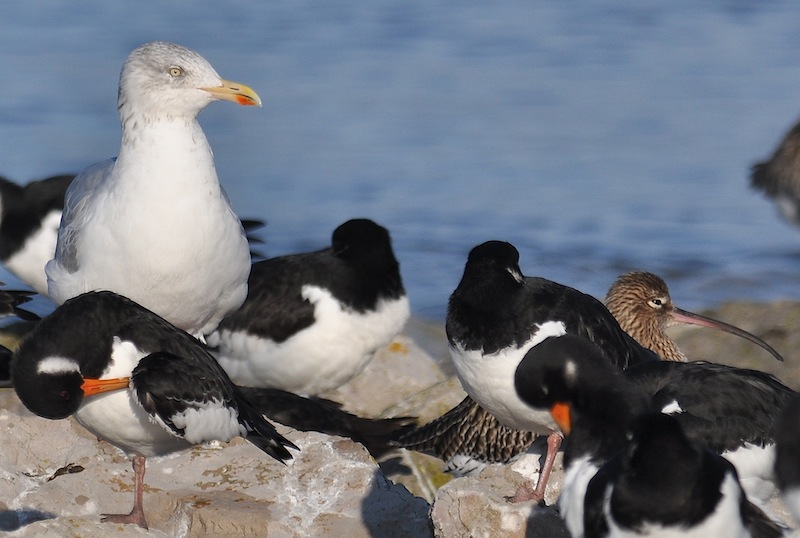
Oystercatchers roosting along with a Curlew and a Common Gull


Curlew


Herring Gull amongst the Oystercatchers


Curlew standing on one leg
A nice little combo !


Oystercatchers going for a dip in the sea
Our final stop at Morecambe was in a small car park at the northern end of the Bay. Whilst eating our sandwiches we had some great views of two female Eider Duck, a single Little Egret, some Black-tailed Godwits, many Lapwing, a few Wigeon, a single Pochard some more Redshank and a lot more Oystercatchers with a couple of Mute Swans flying past us. The light was wonderful here.

Little Egret in amongst the Oycs
Black-tailed Godwits, Oystercatchers, Redshank and a Little Egret 
Mute Swan flypast
Herring Gull, Eider Duck, Black-tailed Godwit and yet more Oycs

Two female Eider Ducks


A male Wigeon separating two females


After lunch we made our way up the coast through Hest Bank and Carnforth (home of the famous railway station featured in the 1945 film 'Brief Encounter') to Leighton Moss RSPB.  Our first stop was at the Eric Morecambe salt marsh hide which has been newly refurbished - well completely rebuilt in actual fact.  Unfortunately there was very little about here and the hazy afternoon sun made viewing difficult.  We did see a Little Egret, two distant Greenshank and perhaps a Spotted Redshank as well as some Teal and a single Snipe.

Female Teal
After this we made our way to the Public Causeway at Leighton Moss in the hope of seeing some Bearded Tits.  We gathered in the usual place by the grit trays and although we did hear them 'pinging' once or twice, the birds didn't show for us today.  However, on leaving the grit trays we got our first brief but distinctive call of a Cetti's Warbler.

Male Shoveler on the edge of the reed bed at the Public Hide


On the way to the Public Hide we heard a Water Rail squealing like a piglet and also a very tame Robin was posing for photographs and even came a sat on one lady's hand.  From the hide we could see Shovelers, Mallards, Coots, Moorhens, Cormorants, Pochard, Mute Swans and Gadwall.

One of several very tame Robins along the Causeway


On the way back from the hide there were still no Bearded Tits showing, but the Cetti's Warbler let rip again with a really loud series of calls - we couldn't see it anywhere though.
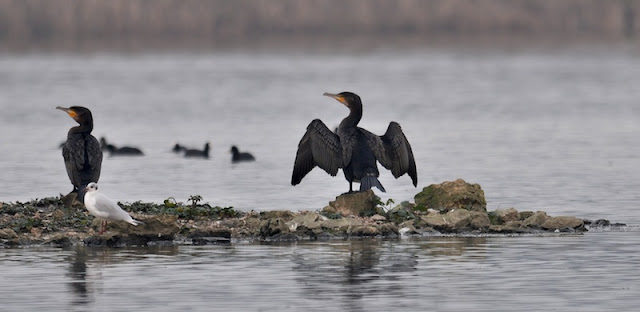
Cormorants, one hanging its wings out to dry


From here we went back to the feeding station behind the RSPB Visitor Centre, stopping on the way to see perhaps 50 to 80 Siskins along with a few Goldfinch high up in one of the Alder trees along the route. At the feeding station there was a Marsh Tit and a Great Spotted Woodpecker as well as the usual ducks.

Siskin in Alder tree


It was now about 4pm and the sun was going down, so we split into two groups for the final event of the day - the Starling roost. One group went into Lillian's Hide whilst the other group went back to the two benches along the high point of the woodland walk on the way to the Causeway from the Visitor Centre.  Some Blue Tits and a Coal Tit could be heard in the trees behind us as we looked across the reserve from this panoramic vantage point and quite a crowd had gathered by now.

A male Marsh Harrier hunting
After waiting in anticipation of the roost, both groups were rewarded with great views of this amazing natural spectacle.  The Starlings seem to appear in smaller groups from various directions and meet up to form a swirling smoke-like mass of birds over the water.


They would twist and turn a while before diving down in to the reed beds.  Whilst we were here, we also got a distant but nice view of a male Marsh Harrier and heard another Water Rail squealing as if someone had stepped on its foot.


There were also a couple of male Pheasants in the field just in front of us and nine Cormorants roosting in a tree on the far side of the water.

Cormorants roosting in a tree
The Starling roost probably lasted around half an hour with periods of activity and then lulls and when there seemed to be no more birds flying in, we decided to call it a day.


It was a fantastic way to end what had been a great day out.  The total count of birds either seen or heard was 77 species for the day - Wow! Thanks must go to Peter for arranging the fieldtrip and to the drivers for the transportation.

Thursday, 8 November 2012

Session 6 - 8th November 2012

The week's session began by finalising the arrangements for next week's full day fieldtrip to Morecambe Bay and Leighton Moss. A party of cars will be leaving from Whitefield Library at 9:30am and several people will be making their own way there to meet on the pay-and-display car park near the stone jetty in Morecambe at about 10:45am.

We went on to have a quick preview of next week's lesson plan, which specified that the habitat would be:
  • Morecambe Bay - coastal seashore at high tide with the main species being waders, seaduck and gulls and particular target birds of Eider, Scoter, Scaup, Bar-tailed Godwit and perhaps even Diver
  • Leighton Moss coastal hides - saltmarsh with the main species being waders, wildfowl and raptors and particular target birds of Spotted Redshank, Red-breasted Merganser and Merlin
  • Leighton Moss RSPB - freshwater lagoons, reedbeds and woodland with the main species being wildfowl and woodland birds and particular target birds of Marsh Tit, Bearded Tit, Bittern and Marsh Harrier as well as the early evening Starling roost.
These coastal wetland environments provide the opportunity to see the largest numbers of species, from wildfowl to buntings. Britain is one of the best places in Europe to see such a diversity due to it's mid-latitude geographical location.

Next we completed our Individual Learning Plans which monitor our progress so far by writing down exactly what Peter told us to!

The main session carried on from last week on the fascinating topic of 'Irruptive Migration', due to the fact that this year is already looking like it may be a good time to see some birds which don't always arrive in Britain in large numbers.  Irruptive migrants are largely dependent on one food source or at least a very limited range of seeds, and if the crops fail in their breeding grounds abroad, the birds can travel long distances to find new sources. Due to this, the birds often arrive in Britain earlier than usual and often in large numbers.

Last week we considered Bramblings and other finches and this week we looked at Waxwings in a little more detail because seven had been reported locally in Barrow near Whalley on 7th November. Peter gave us a map of the location where the birds have been seen, with some ideas about where to look (and park). By visiting the East Lancashire Ornithologists' Club’ website, we later discovered that whilst we were here in Whitefield, 23 Waxwings had appeared in the same location.

The session was finished off by Peter asking us for some target birds for next week. These were:
See you in Morecambe next week!

Birds in Focus - Godwits

There are two species of Godwit to be found in the UK:
Black-tailed Godwits are large wading birds. In summer, they have bright orangey-brown chests and bellies, but in winter they’re more greyish-brown. 

Black-tailed Godwits (RSPB)
Their most distinctive features are their long beaks and legs, and the black and white stripes on their wings. Female Black-tailed Godwits are bigger and heavier than the males, with a noticeably longer beak (which helps the sexes to avoid competing for food with each other). 

They’re very similar to Bar-tailed Godwits, which breed in the Arctic. However, Black-tailed Godwits have longer legs, and Bar-tailed Godwits don’t have striped wings. As the names suggest, the tail patterns are different, too.

Black-tailed Godwit (Martyn Jones)
They are found on estuaries and coastal lagoons are the best places to look for black-tailed godwits at almost any time of year, though they also visit wetland sites inland. Marshside RSPB at Southport is a good place to get closeup views. We also have a small, vulnerable breeding population, on a select few wet meadows and marshes; they migrate to west Africa for winter. Birds from Iceland spend winter in the UK.

It’s easiest to see Black-tailed Godwits from late summer through winter. They eat insects, worms and snails, but also some plants, beetles, grasshoppers and other small insects during the breeding season.

Bar-tailed Godwits (RSPB)
Bar-tailed Godwits are a long-billed, long-legged wading bird which visit UK shores for the winter. Most usually they are seen in their grey-brown 'spangled' winter plumage, whereas birds in spring may show their full rich chestnut breeding plumage. In flight they show no white on the wing unlike the Black-tailed Godwit.

In winter they look very similar in colour and size to the Curlew, except for the bill shape which is straight with a slight upcurve. They eat worms, snails and insects.

In flight a white patch shows stretching from the rump up the back, narrowing to a point. They breed in the Arctic of Scandinavia and Siberia and hundreds of thousands of them pass through the UK, on their way further south, or stop off here for the winter.

The largest numbers of Bar-tailed Godwits occur on large estuaries - the Wash, Thames, Ribble, Dee, Humber, Solway and Forth estuaries, and Lough Foyle for example. They prefer sandy beaches in coastal locations compared to the Black-tailed Godwits which are usually found on inland waters. The highest numbers are seen in Britain between November and February, with numbers starting to build in July and August and falling off in March and April. Small numbers of non-breeding birds can be seen throughout the summer.

This video was taken a Marshside RSPB in June 2012 and shows Black-tailed Godwits (some in the remains of summer plumage) feeding in front of the Sandgrounders Hide at about 1 minute 15 secs.  It also features a Ringed Plover, a noisy colony of breeding Black-headed Gulls and some Avocets.

Birds in Focus - Merlin

Merlin (RSPB)
The Merlin is a compact, dashing falcon with a relatively long, square-cut tail and rather broad-based pointed wings, shorter than those of other falcons. At about 11 inches (28cm) long, it's the UK's smallest raptor (bird of prey) and its small size enables it to hover and hang in the breeze as it pursues its prey.

Merlins are built for aerial chases and has more bulk and muscle than the Kestrel, a bird with which it is easily confused. However, it has broader-based wings and its wingbeat tends to be rapid with occasional glides, wings held close to the body.

The tail is also shorter than a Kestrel's with a rung pattern rather than a black terminal band. Kestrels don't need so much power for hovering and dropping on their prey, whereas the Merlin is a stronger bird eating mainly small birds.  Along with the male Sparrowhawk (to which it also bears some resemblance) and Kestrel, the Merlin can be regarded as part of a 'triple' species.

The place to look for Merlins is lowland and coastal areas where they are often found sitting on posts or stones - indeed the old name for Merlins is 'Stone Falcon'. The adult male bird is a blue-grey colour with an orange-buff chest and a tail with a black terminal band.  Female and immature Merlins are a uniform dark brown colour with darker bands or 'rungs' around the tail.  In flight there is no colour contrast between the 'hand' and the 'arm'.

Merlin in flight (RSPB)
In winter the UK population increases as most of the Icelandic breeding birds migrate to our warmer climate. Although recovering from a population crash in the late 20th century it is still on the Amber List.

The UK breeding population of Merlin is at the south-west extremity of its European range, and is thinly scattered across upland moorland from south-west England north to Shetland.

In winter birds leave upland areas and come down to inland lowland and coastal areas. They can be seen in almost any open country but are often found near coasts. They can be found at roosts in reedbeds, bogs and on heaths, often with Hen Harriers.

The birds are present all year round leaving their upland breeding areas between August and October, when Northern European birds also arrive here.  In summer the RSPB reserves at Forsinard, Highland and Trumland (Orkney) have Merlins. In winter they are regularly seen at: Elmley Marshes, Kent; Northward Hill, Kent; Martin Mere, Lancs; Marshside, Merseyside; Pulborough Brooks, Sussex; and Blacktoft Sands, Yorkshire.

Wednesday, 7 November 2012

Session 5 - 1st November 2012

This week's session started off with a short discussion about next week's full day fieldtrip.  Although we would have liked to go to Marshside for the high tide on Thursday 15th November, it seems that the RSPB are running a 'Big Tide Walk' on that day and there would be potentially a lot of people about as well as competition for limited parking places.

Therefore it was decided to go to Morecambe and Leighton Moss RSPB to look for waders and sea ducks such as Eider, Scaup and Scoter as well as watching the evening Starling roost.  Click here to download a map of Leighton Moss.

We then had a brief discussion about what had been seen since the last session with Jean, Mike, Alan, and me all contributing. Jean had seen what she thought was a male Hen Harrier flying over rough pasture in the Bollington area of the Peak District and after she had described it as pale grey with black wing tips, Peter confirmed her identification.  Mike had seen a number of species in the Nottingham area including Sherwood Forest.  Alan had been on a trip to Spurn Head with the Bolton RSPB and I had been to Robin Hood's Bay, Whitby, Bempton and Flamborough Head on a three day break with my wife, where we had seen Divers for the first time.

After this we looked at a handout on the Ribble Estuary, which is one of the most important places for waders in the whole country as well as being home for seven of the twelve species of British Raptors in winter.

On the south side of the Ribble Estuary the key places to watch birds are at Marshside RSPB, Birkdale beach, Crossens Marsh and Hesketh Out Marsh RSPB, where up to 50 species can be seen in winter if all these sites are taken in.  Click here for an information leaflet.

One of the main topics of this session was 'Irruptive Migrations', particularly of finches and other birds such as:
We then went on to look at which birds we might expect to see on our fieldtrip to the north-west coast next week.  High tide will be at about 12 noon and this will push the birds close to the shore line, making them easier to see.  At Morecambe there is a sandy shoreline with salt water and we hope there will be waders including Knot, Dunlin, Curlew, Redshank, Oystercatcher, Grey Plover and Bar-tailed Godwits (which prefer salt to fresh water) as well as seaduck such as Eider, Scaup and Scoter.

At Leighton Moss, the hides on the salt marshes should have more or less the same waders plus Little Egrets, Red-breasted Merganser, Spotted Redshank and perhaps a raptor or two such as Marsh Harrier, Merlin and Peregrine Falcon. The Great White Egret might even be about somewhere.

We spent a little time looking at the features of some of these birds through a series of handouts, mainly concentrating on two seaduck, Scaup and Scoter. Seaduck are built quite differently to other ducks, being 'broad beamed' to maintain stability in the waves so that they can roll with the tide.

We finished off the session by looking at identifying the different types of Divers, mainly because I had seen some at Bempton Cliffs RSPB earlier this week and had found it hard to be sure which species they were due to the distance and the birds being in winter plumage.

Now our appetite is well and truly whetted for the field trip when some of us will hopefully get to see birds we haven't ever seen before.

Saturday, 3 November 2012

Birds in Focus - Scoter

The Scoter (or Common Scoter to give the full name) is an all dark seaduck, the male is totally black and the female lighter, with a pale face. In fact the male Scoter is the only all-black duck found in Britain.

Scoter are often seen as large bobbing rafts offshore, or long straggling lines flying along the coast. The UK breeding population of this small diving seaduck has substantially declined and it is now a Red List species. In winter, Scoter populations are very vulnerable to oil-spills.

A raft of Common Scoter (RSPB)

In the breeding season the Scoter favours small lochs in N and W Scotland, especially the Flow Country of Caithness and Sutherland. 

In winter Scoter are found off the UK coast with concentrations in Carmarthen and Cardigan Bays, along the Moray Firth, and along the North Norfolk coast.


Scoter can be seen offshore all year round but large numbers arrive from October, leaving from March. They are most likely to be found on breeding grounds in June and July. They feed by diving to the sea bed where they find molluscs and mussels to eat.

Birds in Focus - Waxwing

Waxwing (RSPB)
The Waxwing is a fine-looking albeit slightly plump bird which is slightly smaller than a Starling. It is reddish-brown in colour with a black throat and a prominent crest.  There is a small black mask round its eye, yellow and white in the wings and a yellow-tipped tail.

Waxwings do not breed in the UK, but are winter visitors from October to March, coming in larger numbers known as irruptions in some years when the population on its breeding grounds gets too big for the food available.

There are three subspecies of the Waxwings which visit the UK. These come from:

  • Scandianvia and western Siberia
  • Central and eastern Asia
  • Northern North America

The first British arrivals each winter are usually seen on the east coast from Scotland to East Anglia, but birds move inland in search of food, increasing the chances of seeing one inland. They eat berries, particularly from rowan and hawthorn trees and bushes, but also cotoneaster and rose.

They do seem to like our supermarket car parks, particularly ASDA and TESCO which must plant the vegetation particularly suited to their diet.

UPDATE

The Waxwings have well and truly arrived in Britain this year. Here's a few shots I took at Milner Street in Warrington on Sunday 18  November 2012:


Birds in Focus - Scaup

Male Scaup (RSPB)
Scaup are diving ducks with a resemblance to Tufted Ducks, although they are slightly bigger birds. The males have black heads, shoulder and breast, white flanks, a grey back and a black tail.

An easy way to remember what to look for is 'black at both ends and white in the middle'.  Scaups don't have a tuft on the head and the black on the bill is confined to the 'nail' or tip.

Female Scaup (RSPB)


The female birds are a frosty brown colour with a paler patch on the flanks and they have characteristic white 'ice cream' patches around the base of the bill.

In flight Scaup show white patches along the length of the trailing edge of the wing. Only a handful breed in the UK every year, making them our rarest breeding duck.

In winter, from from late October to March, Scaup are found on estuaries such as the Dee in Cheshire, the Solway Firth, the Firth of Forth and the Moray Firth. A small number occur inland on deeper waters, where they associate with Pochards and Tufted Ducks, the latter with which they are very difficult to distinguish.

Occasionally a Scaup is seen at Pennington Flash and they can  also been found in small numbers on the sea at Morecambe, where Tufted Ducks are not found. Scaup eat shellfish, crustacea and small insects.

Birds in Focus - Brambling

Brambling (RSPB)
Bramblings are a sort of 'northern Chaffinch', a species with which they are frequently found in much smaller numbers and often confused.

Although they are similar in size and shape to the chaffinch, the male has a black head in summer, and an orange breast with white belly. In flight it shows a long white rump. They are gregarious in winter, and may form flocks of many thousands. often joining with chaffinches.

In winter, Bramblings migrate from their breeding grounds in Scandinavia and overwinter in the UK. Numbers can vary between winters depending on the food supplies and reports of the beech mast crop failure overseas might result in the arrival of large numbers of Brambling in the UK this year with several having already been reported in the Greater Manchester area.

In winter Bramblings like beech woodland and farmland fields near woods. Look in flocks of chaffinches and other finches. In autumn look along east coast woodlands and fields. They will visit gardens in winter, eating seeds whilst in summer they eat insects.

Bramblings are usally present in the UK from mid-September until March and April with occasional birds staying into May or even later.

Thursday, 1 November 2012

Join the BTO for £1


As a special incentive to give the British Trust for Ornithology (BTO) membership a try, you can join today for just £1 by direct debit and enjoy six months BTO membership right through until June 2013. For more details click here.


As a BTO member you will receive the full welcome pack, copies of the BTO magazine every other month, 20% discount on Bird ID and survey techniques training courses and contact with your regional BTO representative.

With more members the BTO could do so much more of the survey and science work that is so important for informing conservation.

Click here to apply.