The Pallid Harrier is a migratory bird of prey of the harrier family. It breeds in southern parts of eastern Europe and central Asia and winters mainly in India and southeast Asia. It is a very rare vagrant to Great Britain and western Europe, although remarkably a juvenile wintered in Norfolk in the winter of 2002/3.
This medium-sized raptor breeds on open plains, bogs and heathland. In winter it is a bird of open country. This is a typical harrier, with long wings held in a shallow V in its low flight. It also resembles other harriers in having distinct male and female plumages. Adults measure 40–48 cm long with a wingspan of 95–120 cm. Males weigh 315 g while the slightly larger females weigh 445 g.
The male is whitish grey above and white below, with narrow black wingtips. It differs from the Hen Harrier in its smaller size, narrower wings, pale colour different wing tip pattern.
The female is brown above with white upper tail coverts, hence females and the similar juveniles are often called "ringtails". Her underparts are buff streaked with brown. It is best distinguished from the female Hen Harrier on structure. It is very similar to the female Montagu's Harrier, but has darker and more uniform secondaries from below.
Pallid Harriers hunt small mammals, lizards and birds, surprising them as they drift low over fields and moors. The nest of this species is on the ground. Four to six whitish eggs are laid.
Friday, 19 October 2012
Birds in Focus - Jay
![]() |
| Jay at Burrs Country Park (Martyn Jones) |
They are found all year round across most of the UK, except northern Scotland and live in both deciduous and coniferous woodland, parks and mature gardens. They particularly like oak trees in autumn when there are plenty of acorns and are often seen flying across a woodland glade giving its screeching call.
Jays become more obvious in autumn when they may fly some distance in the open in search of acorns and there seems to be a influx of these birds in Britain at the moment with large groups being seen in some parts of the country. At this time of year they are busily collecting and storing acorns for the winter, but this year's acorn crop is a poor one and Jays are having to travel considerable distances. BirdTrack, the BTO's recording system for bird migration and distribution, has had its highest ever recording rate for Jays last week.
| Jay (Alan Flavell) |
Jays can hoard up to 3,000 acorns in a single month, digging holes with their bills and burying two or three at a time. Most are eaten but the ones that are missed or forgotten are an important way for new oaks to be naturally planted - they are said to be the single most important planter of oak trees in Britain!
The acorn shortage is likely to lead to more Jays visiting gardens in search of food, with their pinky-brown plumage, white rump and black and white wings with a vivid blue flash, they are always a welcome sight. They are often seen at dawn on autumn mornings looking for the large juicy garden spiders that this season brings, although they do eat almost anything including chicks in springtime.
Birds in Focus - Bearded Tit
![]() |
| Male Bearded Tit at Leighton Moss RSPB (Martyn Jones) |
Bearded Tits spend their lives in reedbeds (the only place they are found) but they may move away from breeding areas in winter. Although they can be seen all year round, calm autumn days between 8am and 10am are the best time to look out for them when 'eruptions' sometimes fly high above the reed beds. In spring and summer they eat insects, insect larvae and spiders and their diet changes to seeds in autumn and winter.
Ringing records show that it is mainly juveniles that are involved in the 'eruptions' - once they have completed their moult a proportion fly up above the reedbeds in a rapid climb accompanied by loud 'pinging' calls. Many will plunge straight back into the reeds but a few will fly up again and move off in all directions, stopping only at another reedbed. This is how Bearded Tits are establishing themselves in Scotland, Wales, Northumberland, Cheshire and the Wirral.
The grit trays along the main 'Causeway' at Leighton Moss RSPB are an excellent place to view these birds in October, when they start to change their food source from insects to seeds. The birds need to swallow grit to grind up the grain in their stomachs as part of the digestive process.
![]() |
| Female or Juvenile Bearded Tit at Leighton Moss RSPB (Martyn Jones) |
The cold and very wet April weather also meant an almost total failure of their first nesting attempts (the first time this has ever happened) but since then they have managed to produce good numbers of late broods and some of these birds will be taking to the skies to establish new colonies.
Birds in Focus - Owls
Humans like Owls and seem to have an affinity with them. Perhaps this is due to their human-like features of a rounded face and binocular vision. They even seem to have ears, although what is usually seen are just tufts of feathers which complete their faces. Their facial discs are actually sound receivers which collect and focus the nearby sounds rather like a satellite dish. It's the Owls' hearing that enables them to hunt so well at dusk or in the dark.
There are five species of Owl found in the UK:
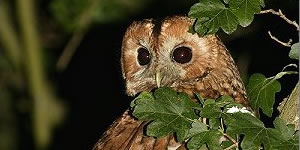
The Tawny Owl is the most common Owl in Britain. It can be found almost anywhere there is mature trees, including woods, parks and large gardens. They nocturnal birds in their hunting but do use exposed perches. The most characteristic feature is perhaps their distinctive call which is well-known to most people but many do not realise that the sound you learn as a child is both the female and male birds calling and answering. The female' sharp 'ke-vick' call is often preceded by the male's 'hoo-hoo-hoo', especially in Autumn.
Most of the calling you hear is that of young males that have dispersed from their parents' territory to find their own. They call from dusk to dawn to establish if another male is nearby. Tawny Owls are very sedentary and rarely move far from their birth place during their whole life. A local Tawny Owl was ringed when it fledged and was found dead 21 years later barely a mile from where it was ringed. Most of the time the Tawny just sits and waits before dropping on its prey - it knows every detail of it's environment and can detect the slightest movement.
The Barn Owl is sometimes called the Screech Owl due to its blood-curdling shriek. They are found in open country such as farmland, meadows and downland. Old barns and trees provide nest sites with rough grassland providing their main food source of voles.
Barn Owls are mainly nocturnal, but when they have young to feed they hunt in daylight. They can be seen over roadside verges and field margins or passing through headlight beams.
Short-eared Owls are found on coastal marshes, moors, fields and young forestry plantations. They are commonest and most widespread in winter due to autumn influxes of Scandinavian birds. The Short-eared Owl hunts in daylight with late afternoon seeing peak activity. They 'quarter' open country fields on long wings and several can hunt in one area if the vole count is high. Harsh 'barking' calls are made during mid-air disputes.
Long-eared Owls are found in areas of scrub and trees, including hedgerows, shelter belts, woods and heathland. They are very secretive and can be very difficult to see as they hunt at night. Communal winter roosts assemble in thick scrubs and late autumn brings the last chance to find 'tired' immigrants resting in the open. The young make 'squeaky gate' begging calls in late spring. Courting males make a low, but far-carrying mournful "oh" sound.
The Little Owl is found in open country with mature trees such as farmland, parkland and downland. It is about the size of a fat Blackbird and has a small stumpy form on fences, telephone poles and the boughs of trees at dusk. Little Owls fly with fast wingbeats and glides, swooping up to a perch. They make a soft but far-carrying "Goo-ek" or "Weew" sound at dusk.
These compact Owls ooze character; they're small but they have attitude, accentuated by their piercing yellow eyes and permanent scowl. Although they might seem at home in here, the Little Owl is the only non-native Owl in the UK. The thousands that now exist in Britain all originate from the few that were released into Northamptonshire the 19th century by Lord Lilford.
Here's a BTO video on identifying Short-eared and Long-eared Owls:
There are five species of Owl found in the UK:
![]() |
| Tawny Owl (RSPB) |
Most of the calling you hear is that of young males that have dispersed from their parents' territory to find their own. They call from dusk to dawn to establish if another male is nearby. Tawny Owls are very sedentary and rarely move far from their birth place during their whole life. A local Tawny Owl was ringed when it fledged and was found dead 21 years later barely a mile from where it was ringed. Most of the time the Tawny just sits and waits before dropping on its prey - it knows every detail of it's environment and can detect the slightest movement.
![]() |
| Barn Owl (RSPB) |
Barn Owls are mainly nocturnal, but when they have young to feed they hunt in daylight. They can be seen over roadside verges and field margins or passing through headlight beams.
![]() |
| Short-eared Owl (RSPB) |
![]() |
| Long- eared Owl (RSPB) |
Long-eared Owls are found in areas of scrub and trees, including hedgerows, shelter belts, woods and heathland. They are very secretive and can be very difficult to see as they hunt at night. Communal winter roosts assemble in thick scrubs and late autumn brings the last chance to find 'tired' immigrants resting in the open. The young make 'squeaky gate' begging calls in late spring. Courting males make a low, but far-carrying mournful "oh" sound.
![]() |
| Little Owl (RSPB) |
The Little Owl is found in open country with mature trees such as farmland, parkland and downland. It is about the size of a fat Blackbird and has a small stumpy form on fences, telephone poles and the boughs of trees at dusk. Little Owls fly with fast wingbeats and glides, swooping up to a perch. They make a soft but far-carrying "Goo-ek" or "Weew" sound at dusk.
These compact Owls ooze character; they're small but they have attitude, accentuated by their piercing yellow eyes and permanent scowl. Although they might seem at home in here, the Little Owl is the only non-native Owl in the UK. The thousands that now exist in Britain all originate from the few that were released into Northamptonshire the 19th century by Lord Lilford.
Here's a BTO video on identifying Short-eared and Long-eared Owls:
Thursday, 11 October 2012
Session 3 - 11th October 2012
Pennington Flash Fieldtrip
Today's session was a fieldtrip to Pennington Flash in Leigh. It was a pretty awful day for going out and about, but that didn't deter the intrepid birders from the Whitefield 'Birds and their Habitat' class. Today we were joined by Barbara from the Ramsbottom class making a total of 12 birders plus Peter.
We got to Pennington Flash at 1:30pm and waited on the car park for everyone to arrive. This area of the Flash is normally very popular with families who feed the ducks, swans and other birds here and this has caused them to amass in great numbers here. Amongst the flocks there were Canada Geese, Mallard, Mute Swans, Black-headed Gulls and a large single resident Muscovy Duck (presumably a farmyard bird or escapee) which to me looks more like a goose than a duck. There was also a small group of Moorhens on the grassy area to the left of the car park and many Coot in the water.
Peter decided to go to Bunting Hide first of all as it has been closing early on some days due to staffing problems and we didn't want to miss it. Bunting Hide is a feeding station and therefore you are nearly always guaranteed a good number and variety of birds there. One of the specialities here is the Willow Tit, a bird that we have recently been discussing in the class and some people come quite a long way to see them here.
Here's a photograph of a Willow Tit that I took here on a previous visit.
Other birds of note here are the very brightly coloured male Bullfinches, of which only one was seen today - but it did look very smart with it's newly developed plumage after the summer moult. Sometimes there can 10 or 12 of these birds feeding here, along with the more subdued coloured females.
There are always a variety of titmice at Bunting Hide and today we saw Coal Tits, Great Tits and Blue Tits. There are also usually a few Long-tailed Tits here (although not strictly one of the titmice Paridae family) but none were seen today. Male and female Chaffinches were also present as well as a huge party of Greenfinches feeding in one of the cages - there were at least 12 of them and I've never seen so many here at once before. Finally there was a Robin, Stock Dove and Moorhen bringing the species count to 10 - not bad for a start!
From Bunting Hide we went on to Horrocks Hide, the largest and possibly best placed of all the other hides. On the way there we had a brief stop to look over the Flash where we saw a Great Crested Grebe, Tutfted Ducks, four or five Pochard in the distance and some Gulls standing on the coloured buoys. Peter pointed out that one of them was a Common Gull with yellowish-green legs and white 'mirrors' on it's wing tips but you really needed a spotting scope to see these features clearly. There were also both Great Black-backed and Lesser Black-backed Gulls on the other buoys.
Horrocks Hide overlooks a long thin strip of land known as 'The Spit', which is the remains of an old railway line that used to pass through this area. In recent weeks the Spit has disappeared altogether under the volume of water caused by the very heavy and frequent rainstorms, but today a fair amount of it was viewable even though the water levels are generally still quite high.

The Spit is often a great place to see waders, but today there were few if any about - even the normally present Lapwing were missing The Cormorant numbers are increasing once again after their absence in the summer and there were at least two white-bellied juveniles at the end of the Spit.
There were also a lot of Canada Geese present. In the pools there were Teal and Mallards, with a Great Crested Grebe in the distance. Perhaps the best bird to be seen today were four Common Snipe which were distant and very well camouflaged as they sat low amongst the vegetation at the far end of the Spit, only occasionally wading in to the water. To the right is a photograph I took of a Snipe here from earlier in the year:
From Horrocks Hide we went on to Tom Edmonson's Hide and the first bird we saw there was a juvenile Grey Heron. The rain was starting to become very heavy by now so we were grateful for the shelter.
The shingle scrapes were all but under water and so there was little chance of any waders, but there were Gadwall, Teal and Mallard pairs feeding here as well as a single pair of the large-billed Shoveler. The drake was just coming out of eclipse and starting to regain it's colour. There was also a male Cuckoo! Wait ... did I say Cuckoo? Well it was actually Peter's excellent impression of a distant Cuckoo which he started up when I mentioned to Alan that I'd heard a Cuckoo here in the spring. I'm sure he's had many people fooled with that one before now!
After the rain had died down a little, we decided to move on. En route to Ramsdale's Hide a blackbird flew across the path and we could hear Long-tailed Tits in the bushes. A member of the class was keen to see a Kingfisher here and it didn't disappoint, first by perching on a submerged post at the far end of the pool and then by flying fast and low across the water in a shimmering iridescent bue blur towards the left side of the hide. Also of note here was a Little Grebe that put in a brief appearance amongst the usuals of Coots and Mallards and some Lapwing were seen briefly overhead. Outside in the trees, more Long-tailed Tits could be heard and Peter said he could also make out a tiny Goldcrest from its call.
Our final call for the day was at Teal Hide, which is a short walk through the trees towards the Golf Course. On the way Peter stopped us to listen again for Long-tailed Tits and also Willow Tits, and there was also a Robin or two along the path. At Teal Hide the water level was very high and so there was little dry land for waders, as has been the case for most of this year. There were however, several pairs of Shovelers, some Gadwall and Coots and a Moorhen here. And then it was time to go home.
So in summary, here's a list of all the birds seen today:
We got to Pennington Flash at 1:30pm and waited on the car park for everyone to arrive. This area of the Flash is normally very popular with families who feed the ducks, swans and other birds here and this has caused them to amass in great numbers here. Amongst the flocks there were Canada Geese, Mallard, Mute Swans, Black-headed Gulls and a large single resident Muscovy Duck (presumably a farmyard bird or escapee) which to me looks more like a goose than a duck. There was also a small group of Moorhens on the grassy area to the left of the car park and many Coot in the water.
| Willow Tit at Bunting Hide, Pennington Flash (Martyn Jones) |
Here's a photograph of a Willow Tit that I took here on a previous visit.
Other birds of note here are the very brightly coloured male Bullfinches, of which only one was seen today - but it did look very smart with it's newly developed plumage after the summer moult. Sometimes there can 10 or 12 of these birds feeding here, along with the more subdued coloured females.
![]() |
| Chaffinch at Bunting Hide |
![]() |
| Greenfinch at Bunting Hide |
![]() |
| A typical view of the end of 'The Spit' - Cormorants and Gulls |

The Spit is often a great place to see waders, but today there were few if any about - even the normally present Lapwing were missing The Cormorant numbers are increasing once again after their absence in the summer and there were at least two white-bellied juveniles at the end of the Spit.
There were also a lot of Canada Geese present. In the pools there were Teal and Mallards, with a Great Crested Grebe in the distance. Perhaps the best bird to be seen today were four Common Snipe which were distant and very well camouflaged as they sat low amongst the vegetation at the far end of the Spit, only occasionally wading in to the water. To the right is a photograph I took of a Snipe here from earlier in the year:
![]() |
| Grey Heron at Edmonson's |
The shingle scrapes were all but under water and so there was little chance of any waders, but there were Gadwall, Teal and Mallard pairs feeding here as well as a single pair of the large-billed Shoveler. The drake was just coming out of eclipse and starting to regain it's colour. There was also a male Cuckoo! Wait ... did I say Cuckoo? Well it was actually Peter's excellent impression of a distant Cuckoo which he started up when I mentioned to Alan that I'd heard a Cuckoo here in the spring. I'm sure he's had many people fooled with that one before now!
![]() |
| Little Grebe at Ramsdale's Hide |
Our final call for the day was at Teal Hide, which is a short walk through the trees towards the Golf Course. On the way Peter stopped us to listen again for Long-tailed Tits and also Willow Tits, and there was also a Robin or two along the path. At Teal Hide the water level was very high and so there was little dry land for waders, as has been the case for most of this year. There were however, several pairs of Shovelers, some Gadwall and Coots and a Moorhen here. And then it was time to go home.
So in summary, here's a list of all the birds seen today:
| Great Crested Grebe | Carrion Crow | Lesser Black-backed Gull | Black-headed Gull |
| Mallard | Moorhen | Common Gull | Canada Goose |
| Coot | Tufted Duck | Willow Tit | Coal Tit |
| Great Tit | Greenfinch | Blue Tit | Chaffinch |
| Stock Dove | Robin | Magpie | Blackbird |
| Grey Heron | Shoveler | Teal | Gadwall |
| Mute Swan | Snipe | Cormorant | Kingfisher |
| Goldcrest (heard) | Long-tailed Tit (heard) | Little Grebe | Pochard |
| Starling | Nuthatch | Lapwing | Greylag Goose |
| Woodpigeon | Cuckoo (NOT!!) |
Some 37 species - not bad for a dull and wet Thursday afternoon.
If there were any more or there are any corrections needed to the text, please let me know by e-mail (geekteacher.mpj@gmail.com).
A great (if a little wet) afternoon out in very pleasant company - now I'm off for some soup and soldiers to warm up a bit - see you next week!
Martyn Jones
Thursday, 4 October 2012
Thank-you
![]() |
| Dunlin at Marshside in September |
It's my intention to write up the topics discussed each week and present them here together with additional photographs and links to other relevant websites. All the information and photographs included will be fully accredited to the person who originates them.
If anyone already has a Flickr album on the internet and would like it included here, just let me know its web address. Or if you'd like to find out about how to put your bird photos online with Flickr, I can set up a free account for you and show you how to upload your photos at the end of one of the sessions.
If you'd like to contribute anything to this website in the form of an article, a trip report or some photographs, please get in touch in class or by e-mail at the address below. In addition, if you find any errors or have any ideas for extending and improving the website, I'd like to hear from you.
Finally, if you'd like to make a comment on a particular post, just click on the word 'Comments' at the bottom of the post, type your message in the text box, choose 'Anonymous' in the 'Comment As' dropdown menu and then click the Publish button. You can include your name in the message if you like.
Martyn Jones (aka GeekTeacher)
geekteacher.mpj@gmail.com
Session 2 - 4th October 2012
Today's session started with Peter listing the 62 bird species he saw this week on a five hour trip to the Wirral Peninsula.
Of particular note were two Great White Egrets at Parkgate, two juvenile Marsh Harriers at Burton Mere Wetlands RSPB, a Sandwich Tern at Hoylake and a Rock Pipit at Red Rocks.
All the above links are to the excellent Dee Estuary Birding website from which this map was also downloaded.
We then went on to look at an article from the Yorkshire Post (29/09/12) about autumn migrants on the east coast this year.
Our main focus in the article was on the Yellow-browed Warblers which have been brought to such places as Spurn Point on the Yorkshire coast by this week's strong winds and heavy rain.
The Yellow-browed Warbler breeds in the Ural Mountains across Asia and usually migrates through China to wintering areas from central Nepal southwards to the Malay Peninsula. But some birds seem to be changing their migration pattern and are arriving in the UK in increasing numbers each autumn. In October 2005, 1250 of these small warblers were recorded in the UK - so how many were there actually present and how many first set off from the Urals? The species is no longer a rarity here as it once used to be - it is now the most common Siberian migrant to pass through the UK.
Yellow-browed Warblers have now been recorded in most European countries and even in Senegal, Africa. The question as to why this is happening and what is making them migrate in a completely different direction is perhaps due to the considerably shorter distance than the traditional route to south-east Asia.
During the course of reading this article we also discussed the concept of faunal zones or ecozones and in particular the Western Palearctic and Eastern Palearctic zones of Eurasia.
These are large areas of the planet's surface with their own distinctive fauna and flora due to physical boundaries such as mountain ranges, oceans and deserts.
Here in the UK we are are in the Western Palaeartic zone and the Yellow-browed Warblers have flown in from the Eastern Palaeartic where the avifauna is quite different.
Following this very interesting discussion we went on to recap the weather conditions needed to produce good 'falls' of migrants landing in the UK during Autumn. Many Scandinavian songbirds migrate south-east over the North Sea for the winter and they set off during a period of high pressure when the skies are clear and the winds are light. They usually fly at night when there is less chance of predation and they can easily use the stars and moon to navigate, along with the earth's magnetic field.
However, if they meet a low pressure weather system from over the Low Countries (Netherlands, Belgium, Northern France etc) where the winds are much stronger and in the opposite (easterly) direction, they can be forced off course and need find land on the east coast of Britain, rather than ditching in the sea where they would probably die. Therefore, the criteria for good numbers of autumn migrants on the east coast are:
Conditions such as these can bring a whole host of common birds and rarities to places such as Spurn Point, which is a very popular place for birders in Autumn provided the weather conditions are right.
A bird observatory has been set up here as it is a key recording site for the UK and you can even book an overnight stay there for just £12 if the fancy takes you.
On the west coast of the UK, autumn is good time for seeing seabirds blown close inshore and even inland from the Irish Sea and Atlantic Ocean. The weather conditions which facilitate this are strong to gale-force westerly winds from the Atlantic. These will bring in such pelagic (ocean-going) birds as Shearwaters, Petrels, Skuas, scarce Gulls and Phalaropes and October is a good month to see all these species.
Of particular note were two Great White Egrets at Parkgate, two juvenile Marsh Harriers at Burton Mere Wetlands RSPB, a Sandwich Tern at Hoylake and a Rock Pipit at Red Rocks.
All the above links are to the excellent Dee Estuary Birding website from which this map was also downloaded.
We then went on to look at an article from the Yorkshire Post (29/09/12) about autumn migrants on the east coast this year.
Our main focus in the article was on the Yellow-browed Warblers which have been brought to such places as Spurn Point on the Yorkshire coast by this week's strong winds and heavy rain.
The Yellow-browed Warbler breeds in the Ural Mountains across Asia and usually migrates through China to wintering areas from central Nepal southwards to the Malay Peninsula. But some birds seem to be changing their migration pattern and are arriving in the UK in increasing numbers each autumn. In October 2005, 1250 of these small warblers were recorded in the UK - so how many were there actually present and how many first set off from the Urals? The species is no longer a rarity here as it once used to be - it is now the most common Siberian migrant to pass through the UK.
Yellow-browed Warblers have now been recorded in most European countries and even in Senegal, Africa. The question as to why this is happening and what is making them migrate in a completely different direction is perhaps due to the considerably shorter distance than the traditional route to south-east Asia.
During the course of reading this article we also discussed the concept of faunal zones or ecozones and in particular the Western Palearctic and Eastern Palearctic zones of Eurasia.
These are large areas of the planet's surface with their own distinctive fauna and flora due to physical boundaries such as mountain ranges, oceans and deserts.
Here in the UK we are are in the Western Palaeartic zone and the Yellow-browed Warblers have flown in from the Eastern Palaeartic where the avifauna is quite different.
Following this very interesting discussion we went on to recap the weather conditions needed to produce good 'falls' of migrants landing in the UK during Autumn. Many Scandinavian songbirds migrate south-east over the North Sea for the winter and they set off during a period of high pressure when the skies are clear and the winds are light. They usually fly at night when there is less chance of predation and they can easily use the stars and moon to navigate, along with the earth's magnetic field.
However, if they meet a low pressure weather system from over the Low Countries (Netherlands, Belgium, Northern France etc) where the winds are much stronger and in the opposite (easterly) direction, they can be forced off course and need find land on the east coast of Britain, rather than ditching in the sea where they would probably die. Therefore, the criteria for good numbers of autumn migrants on the east coast are:
- A high pressure weather system (cyclone) over Scandinavia
- Easterly winds blowing in from the North Sea
- A low pressure weather system (anticyclone / depression) over the southern North Sea
![]() |
| Spurn Point |
Conditions such as these can bring a whole host of common birds and rarities to places such as Spurn Point, which is a very popular place for birders in Autumn provided the weather conditions are right.
A bird observatory has been set up here as it is a key recording site for the UK and you can even book an overnight stay there for just £12 if the fancy takes you.
On the west coast of the UK, autumn is good time for seeing seabirds blown close inshore and even inland from the Irish Sea and Atlantic Ocean. The weather conditions which facilitate this are strong to gale-force westerly winds from the Atlantic. These will bring in such pelagic (ocean-going) birds as Shearwaters, Petrels, Skuas, scarce Gulls and Phalaropes and October is a good month to see all these species.
We briefly finished this section by recapping on the weather conditions that can make a productive trip to Parkgate on the Wirral at this time of year. Parkgate is well-known for it's high tides bringing in raptors hunting for the rodents and small mammals that are trying to escape the rising water levels on the marshland. However, the conditions need to be just right, so:
- Choose a high tide in October or March
- Look for a tide above 10 metres
- North westerly winds are needed to push the tide further up the Dee Estuary than normal
With this in mind, Peter issued the class with a printout of the Sunday high tides for October 2012 and I'm lucky enough to be going to the first one on Sunday 7th October.
Next we went to have a look at last week's 'homework', which was to read an article on how to identify the 'twin species' of Marsh Tits and Willow Tits. These are discussed in the 'Birds in Focus' section of this website.
The main session was then concluded by discussing the arrangements for next week's field trip to Pennington Flash in Leigh, with the focus being on the birds that might be seen on our visit. More on than next week.
Finally, I presented this website to the class and I'm pleased to say that it seemed to be well-recieved by Peter and the other members. I've written a little 'Thank-you' here, together with a few more details about the aims of the website and how people can contribute to it.
UPDATE
Would you believe it? A Yellow-browed Warbler has been reported at the Wigan Flashes on Saturday 6th October. Watch out for the rush !
![]() |
| Birds and their Habitats Website |
Finally, I presented this website to the class and I'm pleased to say that it seemed to be well-recieved by Peter and the other members. I've written a little 'Thank-you' here, together with a few more details about the aims of the website and how people can contribute to it.
UPDATE
Would you believe it? A Yellow-browed Warbler has been reported at the Wigan Flashes on Saturday 6th October. Watch out for the rush !
Birds in Focus - Gulls
Gulls can be one of the most difficult of birds to identify, so much so that many birders don't bother! There are so many variations in colour and plumage depending on the age of the bird and the season. However, Gulls can be the most numerous of all the birds on a particular site and a large flock may indeed consist of four or five different species. Here we concentrate only on adult birds.
Criteria for the identification of Gulls
- BPC - Bare Parts Colour - anything without feathers on it, i.e. leg, bill and eye colour
- Upper wing colour and pattern
There are five main species of Gull that can usually be found on most large bodies of inland water:
- Black-headed Gull - smallest of the five species with red legs and red bill with a black tip
- Common Gull - greenish yellow legs with white 'mirrors' on the wing tips which appear rounded. Black eye.
- Herring Gull - pink or flesh legs and yellowish bill and silvery grey upper wing colour. Pale 'beady' eye.
- Lesser Black-backed Gull - yellowish legs with slaty grey upper wing colour
- Great Black-backed Gull - pink or flesh coloured legs with black upper wing colour. A very large bird.
Other Gulls which are scarcer but which can usually be seen in North West England include:
Birds in Focus - Marsh Tit and Willow Tit
![]() |
| Willow Tit (RSPB) |
![]() |
| Marsh Tit (RSPB) |
- Voice or call
- Distribution - i.e. where it's found
- Head colour and appearance - Marsh Tit has a glossy black cap, whereas the Willow Tit's is dull black
- Wing panel colour - Willow Tit has a pale patch on the inner wing which Marsh Tit lacks
The bird's call is a surefire way of identifying each bird, but what if it's not heard? There is increasing evidence to show that the other three methods are not always as conclusive as first believed because both birds can at times display similar features.
Recent suggestions for telling the two birds apart are:
- A 'smeary' white mark at the base of the Marsh Tit's upper mandible which is missing on the Willow Tit
- Grey-brown hues on at the neck-sides on the Marsh Tit compares to warm buff hues on the Willow Tit
The best place to see these birds in North West England are:
- Marsh Tit - Leighton Moss RSPB
- Willow Tit - Pennington Flash Country Park or Astley Moss
Whichever method is correct, the two birds obviously give even the experts plenty to discuss and so for many birders the chosen method will still be voice first, followed quickly by distribution.
Here's a BTO identificartion video:
Thursday, 27 September 2012
Session 1 - 27th September 2012
![]() |
| Great Crested Grebe at Pennington Flash - Martyn Jones |
The Whitefield class was attended by 10 people including myself, for whom it was the first ever session. Most of the other members seemed to know each other from previous years and at least one person had joined this class from one of the partner groups. They're a friendly bunch of people, so that's a good start.
After the initial formalities of signing the learning agreements, reading the aims of the course and other general course administration, Peter began the session by talking about the weather, a very topical subject due to the adverse conditions the UK has been experiencing over the last week, if not the whole 2012 summer.
![]() |
| No wonder we're depressed ! |
In particular he talked about how weather conditions and affect birds and bird sightings. In a low pressure system (depression or anticyclone), the winds move in an anti-clockwise direction this bringing birds in from the Atlantic Ocean on to our western shores and sometimes inland.
In a high pressure system or cyclone, the winds move in a clockwise direction and thus bring birds from the North Sea on to our eastern coastlines. Therefore it is very important to watch the weather when trying to predict what may be seen in a specific area.
From this discussion we went on to have a short quiz about two birds Peter saw recently in Mallorca - this was an exercise in using the field guides to match descriptions and localities. The two birds were both named after people: Auduoin's Gull and Eleonora's Falcon. This work came under the title of 'Birds in History and Culture'. Click the links above for a summary.
After reading through some handouts on habitats and discussing the best places to observe birds in autumn and winter, we went on to examine the shape and structure of the five species of Grebe that can be seen in the UK, a summary of which can be found here.
![]() |
| Marsh Tit - RSPB Website |
![]() |
| Willow Tit - RSPB Website |
This is an example of what Peter calls 'twin species' and which an underlying theme of all the sessions this year. Other examples include Greenshank and Spotted Redshank
A very informative and enjoyable session with a group of friendly and sociable birders whom I hope to get to know better over the coming months.
Subscribe to:
Posts (Atom)